Prompt Weighting for Video Scenes: How Better Wording Improves AI Motion
Learn how prompt weighting for video scenes helps beginners guide camera movement, subject action, and style more clearly when creating videos from text in Movi AI.

By Movi AI Team
Movi AI Editorial Team
Prompt weighting is a useful technique for people who want more control over AI-generated scenes. Instead of treating every word in a prompt as equally important, you can emphasize the parts that matter most, like the subject, action, camera movement, or visual style. For beginners using *Movi AI*, this creates a simpler path to clearer and more consistent results.
What prompt weighting means in practice
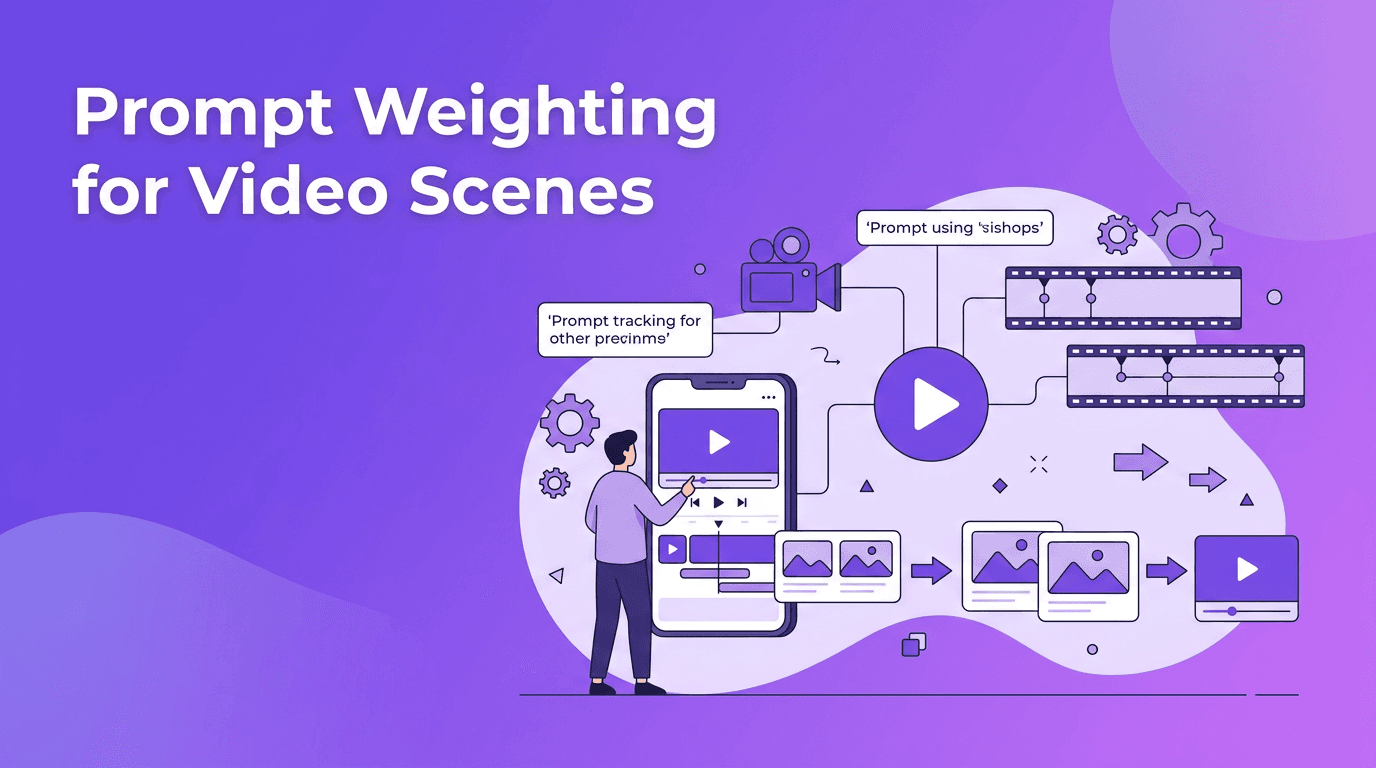
When you write a video prompt, the model tries to interpret many signals at once. If the wording is vague, the result may look random. With prompt weighting, you make the hierarchy clearer. You can place the main subject first, describe the action second, and add style or environment details after that. This helps the model understand what should dominate the final clip.
- High priority: main subject and action
- Medium priority: setting, time of day, mood
- Lower priority: extra texture, minor props, secondary details
Bad prompt vs good prompt
A weak prompt might say: 'beautiful city, cinematic, person walking, night, neon, dramatic'. It includes useful words, but the focus is unclear. A stronger version is: 'A young woman walks through a neon-lit city street at night, medium tracking shot, light rain, reflective pavement, cinematic realism'. The second prompt gives the model a clearer order of importance.
How AI models interpret weighted prompts
Different AI systems do not read prompts in exactly the same way. Some models behave more like diffusion systems, building frames from noise and gradually shaping visual details. Others use transformer-based structures to connect language, scene logic, and temporal consistency across frames. Because of that, prompt weighting can produce slightly different outcomes from one model to another.
In simple terms, diffusion-based approaches often respond strongly to descriptive visual tokens such as lighting, lens feel, texture, and style. Transformer-based approaches may do a better job with sequence logic, such as who moves first, where the camera goes, and how one event leads into another. That is why testing small prompt variations matters.
"Better prompts do not just describe a scene, they tell the model what deserves attention first."
Prompt structure that usually works well
- Subject: who or what is on screen
- Action: what is happening
- Camera: wide shot, close-up, pan, dolly, tracking
- Setting: where the scene takes place
- Style: realistic, animated, sketch, cinematic, minimal
- Output choices: vertical, square, landscape, short duration
Practical settings that improve results
Prompt wording is only one part of the outcome. You should also match the prompt to your intended format. If you are making content for Reels or Shorts, choose a 9:16 aspect ratio. For YouTube or presentations, 16:9 often works better. Shorter clips usually hold motion quality better, especially when the prompt asks for one clear action instead of several competing actions.
- Use one main action per clip for cleaner motion
- Choose an aspect ratio based on the platform
- Keep prompts specific, but not overloaded
- Use style keywords only if they support the goal
- Test two or three variations instead of rewriting everything
How beginners can use prompt weighting in Movi AI
*Movi AI* makes it easier to experiment with prompt weighting because you can quickly generate clips from text, images, or existing videos without needing a complex editing workflow. Start with a simple scene idea, generate a first draft, then refine the subject, motion, and camera wording step by step. This iterative method is faster than trying to write the perfect prompt on the first attempt.
Try prompt-based video creation in Movi AI
Create clips from text prompts, images, or existing footage with a beginner-friendly workflow built for faster visual content.
Download Movi AIWhere this technique is most useful
- Product teasers that need one clear hero shot
- Social media clips with simple, strong motion
- Concept videos for creators testing visual ideas fast
- Marketing experiments where style and framing matter
- Educational visuals that need precise scene direction
Frequently Asked Questions
What is prompt weighting in AI video creation?
Prompt weighting is the practice of emphasizing the most important parts of a prompt, such as the subject, motion, or camera direction, so the model prioritizes them more clearly.
How do I write better prompts for AI video tools?
Start with the subject, then describe the action, camera framing, setting, and style. Keep the scene focused on one main action for better motion.
Do different AI models understand prompts differently?
Yes. Diffusion-based and transformer-based systems can respond differently to the same prompt, especially around motion consistency, detail, and sequence logic.
What aspect ratio should I use for AI-generated video?
Use 9:16 for vertical social content, 1:1 for square posts, and 16:9 for YouTube, websites, or presentations.
Movi AICreate stunning AI videos in seconds!
Turn your ideas into professional videos with the #1 AI video maker.
Download Movi AI